
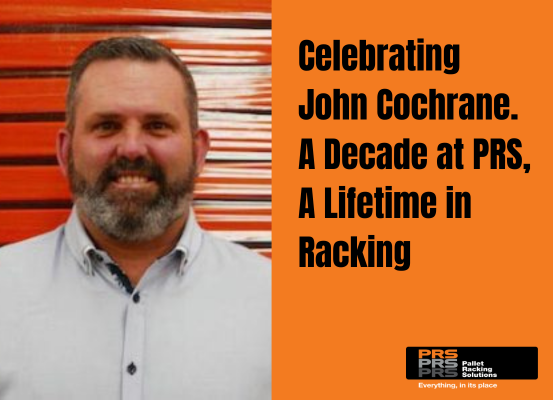

With 35 years of experience in racking, Pallet Racking Solutions Senior Account Manager John Cochrane didn’t plan on a career in pallet racking — he just needed a job.
Straight out of school at 17, with no qualifications and not much interest in the classroom, his dad gave him simple advice: get to work. A mate helped him land a role on the paint line at a local manufacturer, and when an opportunity came up to step onto a machine, he took it – and never looked back.
What started as a job quickly became a career. The company — Victor Industries — was more than just a workplace. With around 150 people on site, it supported entire families, including his own. His dad joined as an engineer not long after he started, and over time, his brother and extended family joined too.
John wanted to be able to ‘do it all’ so he worked in every department — roller doors, the factory floor, overtime whenever it was available. By 21, he’d bought his first house. By 24, he was the factory manager.
Victor was one of only a handful of pallet racking manufacturers in New Zealand at the time — and eventually, the only one left. It supplied major names like The Warehouse and built a reputation for strong, reliable, locally made products. Some of that racking is still in use today, recycled and repurposed two or even three times over more than 30 years — something John still takes pride in when he sees it come in the door.
But the industry didn’t stand still.
The Global Financial Crisis in 2010 hit hard, and Victor went into receivership. That moment reshaped everything. Manufacturing in New Zealand became increasingly expensive, and the market began shifting toward imported systems and more diverse product ranges. He stayed in the game, helping start Multirack after Victor’s closure, moving into sales and leadership roles, eventually becoming the GM.
The Christchurch earthquakes in 2010 and 2011 were another turning point. Suddenly, compliance, seismic design, and safety standards became critical. What was once informal — no consents, minimal oversight — became highly regulated. PS1s, load calculations, and engineered designs became the norm.
At the same time, warehousing itself was evolving. Buildings got taller — from 6 metres to 30. Aisles got narrower. Automation and articulated machines changed how space was used. Systems like shuttle racking, once niche, became mainstream. The industry became more technical, more precise, and more accountable.
Through it all, John adapted. From manufacturing to sales, from factory floor to leadership, and eventually into his current role at Pallet Racking Solutions, where he returned to what he enjoys most — working directly with customers. John started in 2016 was there when the company was a small team of 10. Today, it’s grown to more than 30 in Auckland alone.
John has travelled to China to work on quality control and product development, helped design new systems, and worked alongside engineers to improve everything from baseplates to anchoring methods. He’s seen the product range evolve from just frames and beams to nearly anything a warehouse could need.
But for him, the real satisfaction hasn’t changed.
It’s in seeing a system installed and working. Knowing the product will last for decades. In spotting old Victor racking still standing strong — sometimes on its third life.
After 35 years, it’s not just about steel and structures. It’s about building something that lasts — and being part of an industry that never stops evolving.

Pallet Racking Solutions designs, supplies and installs quality pallet racking and warehouse storage solutions, New Zealand wide. Follow our blog for the latest innovations, new tech, safety and compliance, case studies and in-depth explanations of our solutions.