
Pallet Racking Solutions designs, supplies, and installs narrow aisle pallet racking across New Zealand — configured for maximum storage density and efficiency, using standard pallet racking components with aisles spaced closer together. This reduces wasted aisle space and lets pallets be stored at greater density, maximising your warehouse’s 3-dimensional space.


Narrow Aisle Pallet Racking (sometimes called VNA — Very Narrow Aisle) combines a wealth of features to enable the best possible use of space and fast order-picking. PRS designs and installs these systems for a wide variety of industries where warehousing space is limited. The design is one-deep, so every pallet is immediately accessible — versatile and flexible enough to suit facilities handling large volumes of multiple product lines.
Height-adjustable beams give maximum flexibility with articulated fork trucks or man-up order-picking stackers. PRS can also supply and install the guidance systems needed to operate safely in narrow aisles.
There are two main types of guidance systems:
Mechanical rail guidance — rails installed in each aisle guide the forklift trucks, which are fitted with rollers, keeping them on track. Guide rails can be installed at various heights to suit your first racking level.
Inductive or wire guidance — cables installed under the aisle floor connect to sensors on the forklift, automating movement and eliminating lateral deviation.
The increase in racking density achievable with narrow aisle racking is significant — aisles can be reduced by up to 1.5 metres or more, as low as approximately 1.65 metres depending on truck type, increasing available storage space by as much as 40%.
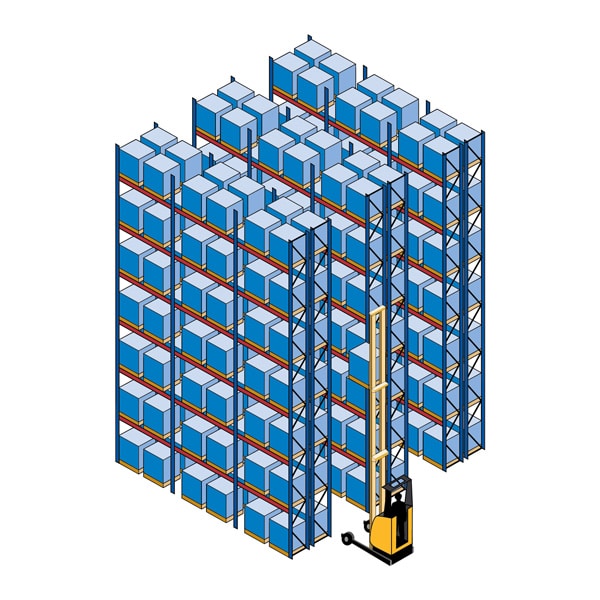
Narrow Aisle Pallet Racking – Common Specifications
| Truck Type | Min Aisle Width | Max Rack Height | Typical Load per Level |
|---|---|---|---|
| Articulated forklift | 1.8m | 14m | 1,200kg |
| Turret truck | 1.65m | 13m | 1,200kg |
| Man-up order picker | 1.65m | 13m | 1,200kg |
Narrow aisle pallet racking (sometimes called VNA – Very Narrow Aisle) uses conventional racking components with aisles spaced more closely together. It maximises storage density by reducing aisle width (as low as ~1.65 m), giving full access to every pallet, and requiring specialised forklift or guidance systems to load and retrieve safely.